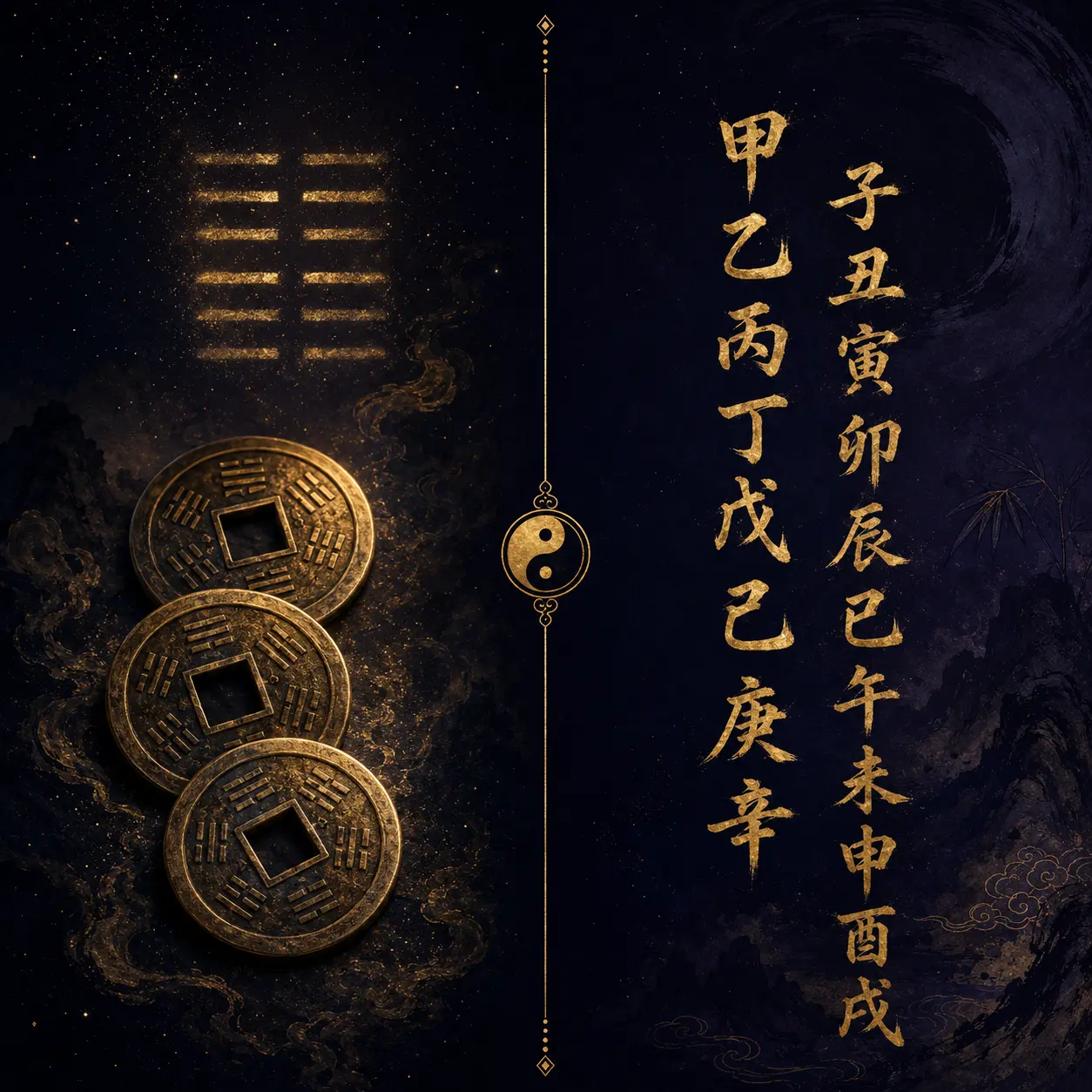
Two of the oldest Chinese systems for understanding fate share the same cultural roots, yet answer completely different questions. The I Ching (易經) gives you advice for a specific decision you’re facing right now. BaZi (八字) maps the elemental pattern of your entire life from your birth time. Confusing them — or assuming you have to pick one — is the most common mistake newcomers make.
This guide breaks down what each system actually does, how they differ, and how serious practitioners use them together.
Try it yourself: cast a free I Ching reading at YISHU INSIGHT, or generate your full Zi Wei Dou Shu chart here — no signup.
What I Ching Actually Does
The I Ching — also written Yi Jing (易經) and called the Book of Changes — is one of the oldest Chinese classics, with origins traced back over 3,000 years. According to the Zhouyi tradition, King Wen of Zhou (周文王) arranged the 64 hexagrams while imprisoned by the Shang dynasty around 1100 BCE. Confucius later wrote the Ten Wings (十翼) commentaries that turned the divination manual into a philosophical text.
You consult the I Ching by asking a focused question, then generating one (or two) of 64 hexagrams — six-line figures built from yin (⚋) and yang (⚊) lines. The hexagram, plus any “changing lines,” produces a specific reading that addresses your situation.
I Ching answers questions like:
- Should I accept this job offer?
- How will my conversation with my partner this weekend go?
- Is now the right moment to start the project?
- What energy is at work in this conflict, and how do I navigate it?
It’s on-demand divination — you cast a reading whenever you need one. Two readings on the same question, days apart, may produce different hexagrams because the surrounding situation has shifted.
For a step-by-step walkthrough, see our free I Ching reading online guide, or read how to ask the I Ching the right question before you start.
What BaZi Actually Does
BaZi (八字) — literally “Eight Characters” — is also called Four Pillars of Destiny (四柱命理). It builds your chart from four pairs of Heavenly Stems (天干) and Earthly Branches (地支), one pair each for your birth year, month, day, and hour. That’s eight characters total — hence the name.
The system is grounded in Five Element theory: the chart is essentially a snapshot of how Wood (木), Fire (火), Earth (土), Metal (金), and Water (水) interacted at the moment you were born. Your birth chart is fixed for life. What changes are the Luck Pillars (大運) — 10-year cycles that overlay new elemental energies onto your natal pattern.
BaZi answers questions like:
- What is my core personality and life direction?
- Which industries or careers fit my elemental balance?
- What 10-year period am I entering, and what should I focus on?
- When are my strongest years for wealth, marriage, or major decisions?
It’s fixed natal analysis — once cast at birth, your eight characters never change. The skill is in reading how your fixed chart interacts with each year and decade.
Head-to-Head Comparison
| Dimension | I Ching | BaZi |
|---|---|---|
| Type | Event-specific divination | Lifetime natal analysis |
| Method | Coin toss / yarrow stalks → hexagram | Birth time → 8 characters |
| Output | One of 64 hexagrams | Fixed chart of stems and branches |
| Time horizon | This question, this moment | Your entire life |
| Casting frequency | Whenever needed | Once |
| Birth data needed | None (just the question) | Year, month, day, hour |
| Theoretical base | Yin-yang, hexagram symbolism | Five Elements, stem-branch interactions |
| Best for | Decisions and timing | Personality, career, life patterns |
| Learning curve | Moderate — 64 hexagrams to know | Steep — element relationships are subtle |
| Major variants | King Wen, Plum Blossom, Liu Yao | Modern reform, classical Zi Ping |
Seven Concrete Differences
1. Question vs. Person
I Ching is a question-asking tool. You bring a problem, you receive a hexagram, you act. BaZi is a person-reading tool. The chart is you — your character, your patterns, your decade-by-decade trajectory.
If a friend asks “Should I quit my job?” — that’s I Ching territory. If they ask “Is my career path even suited to me?” — that’s BaZi.
2. On-Demand vs. Fixed at Birth
You can cast an I Ching reading right now without knowing anything about yourself. You need an exact birth time (ideally to the minute) for BaZi to be useful. If your birth records are incomplete, I Ching is the more accessible option.
3. Hexagrams vs. Five Elements
I Ching’s symbolic language is the 64 hexagrams plus their changing lines — over 4,000 unique reading combinations. BaZi runs on Five Element theory — Wood feeds Fire, Fire produces Earth, Earth bears Metal, Metal generates Water, Water nourishes Wood. The framework is more constrained but applies system-wide.
4. Resolution vs. Reach
I Ching gives you high resolution on a single point — what’s happening right now in this exact situation. BaZi gives you low resolution over a long range — what kind of decade, year, or life phase you’re in.
You wouldn’t use a microscope to read a roadmap, and you wouldn’t use a roadmap to examine a cell. They’re different tools.
5. Practitioner Independence
I Ching readings can be cast and read by yourself with practice — many people self-consult daily. BaZi rewards experienced interpretation; getting useful insight from your own chart usually requires either years of study or a skilled reader.
6. Cultural Footprint
According to academic research on East Asian divination practices, BaZi is the more widely practiced natal system across Mainland China, Taiwan, Hong Kong, Singapore, Malaysia, Korea, and Japan. The I Ching has broader philosophical reach — it’s studied by scholars of Confucianism, Taoism, and even Western thinkers like Carl Jung — but its divinatory use, while ancient, varies in popularity by region.
7. Verifiability
Both systems are difficult to test in controlled conditions. I Ching predictions are bounded (a single event with a near-term outcome), so feedback is fast. BaZi predictions span decades, so individual claims often can’t be verified until much later — and confirmation bias has plenty of time to set in.
When to Use Which (Decision Rules)
Use I Ching when:
- You face a specific upcoming decision
- You want guidance on timing — should I do this now, or wait?
- You don’t know your exact birth time
- You want a reading you can repeat as the situation evolves
- You’re seeking philosophical or symbolic insight, not just prediction
Use BaZi when:
- You want to understand your long-term life pattern
- You’re choosing a career or industry direction
- You’re trying to understand a relationship’s compatibility (BaZi pairing)
- You know your birth time precisely
- You want to map out your next 10-year Luck Pillar
Use both when:
- You’re making a major life decision (BaZi for the strategic context, I Ching for the tactical call)
- You’re working with a professional reader who incorporates multiple systems
- You want to cross-check guidance — when both systems point the same direction, confidence rises
How They Differ from Zi Wei Dou Shu
If you’re now wondering where Zi Wei Dou Shu (紫微斗数) fits — it’s the third major Chinese system, and it sits closer to BaZi than to I Ching. Like BaZi, Zi Wei Dou Shu is a natal system based on birth time. Unlike BaZi, it uses 100+ stars across 12 life palaces instead of Five Elements.
For a deeper dive, see Zi Wei Dou Shu vs BaZi: which Chinese astrology system fits you and I Ching vs Tarot: how do they actually compare.
A Practical Workflow
If you’re new to all this and just want to try a system that gives results today, start with I Ching. It needs no birth data, the feedback loop is fast, and the 64 hexagrams give you a vocabulary for understanding situations even when you’re not casting a reading.
If you’re committed to long-term self-understanding, get a proper BaZi reading (or learn the basics yourself). Knowing your day master and elemental balance reframes a lot of life decisions — career, relationships, where to live.
Serious practitioners eventually use both. The I Ching handles what’s happening now. BaZi handles who you are over time. Add Zi Wei Dou Shu and you have a triangulation: hexagram for the moment, eight characters for the personality, twelve palaces for the life events.
Common Questions
Q: Do I need to believe in I Ching or BaZi for them to work? The systems are tools for structured reflection, regardless of metaphysical commitment. Even skeptics often find that being forced to articulate a question (I Ching) or contemplate a fixed chart (BaZi) surfaces useful self-knowledge. Whether the results are “real” predictions or sophisticated projection is a debate you can have after you’ve tried them.
Q: Can my I Ching reading contradict my BaZi chart? Apparently, yes — that’s actually informative. If your BaZi suggests a strong period and your I Ching reading on a specific decision is cautionary, it usually means the macro trend is favorable but the specific timing of this particular move isn’t. Both can be right at different scales.
Q: Which has more variants and schools? BaZi has more academic schools (the Modern Reform school, the classical Zi Ping school, Mang Pai — the Blind School, etc.). The I Ching has fewer schools but more methods of casting (yarrow, three coins, plum blossom numerology, six-line method / Liu Yao). Pick a method that suits you and stick with it long enough to develop intuition.
Try a free I Ching reading at YISHU INSIGHT, or generate your free Zi Wei Dou Shu chart for the natal-system equivalent.