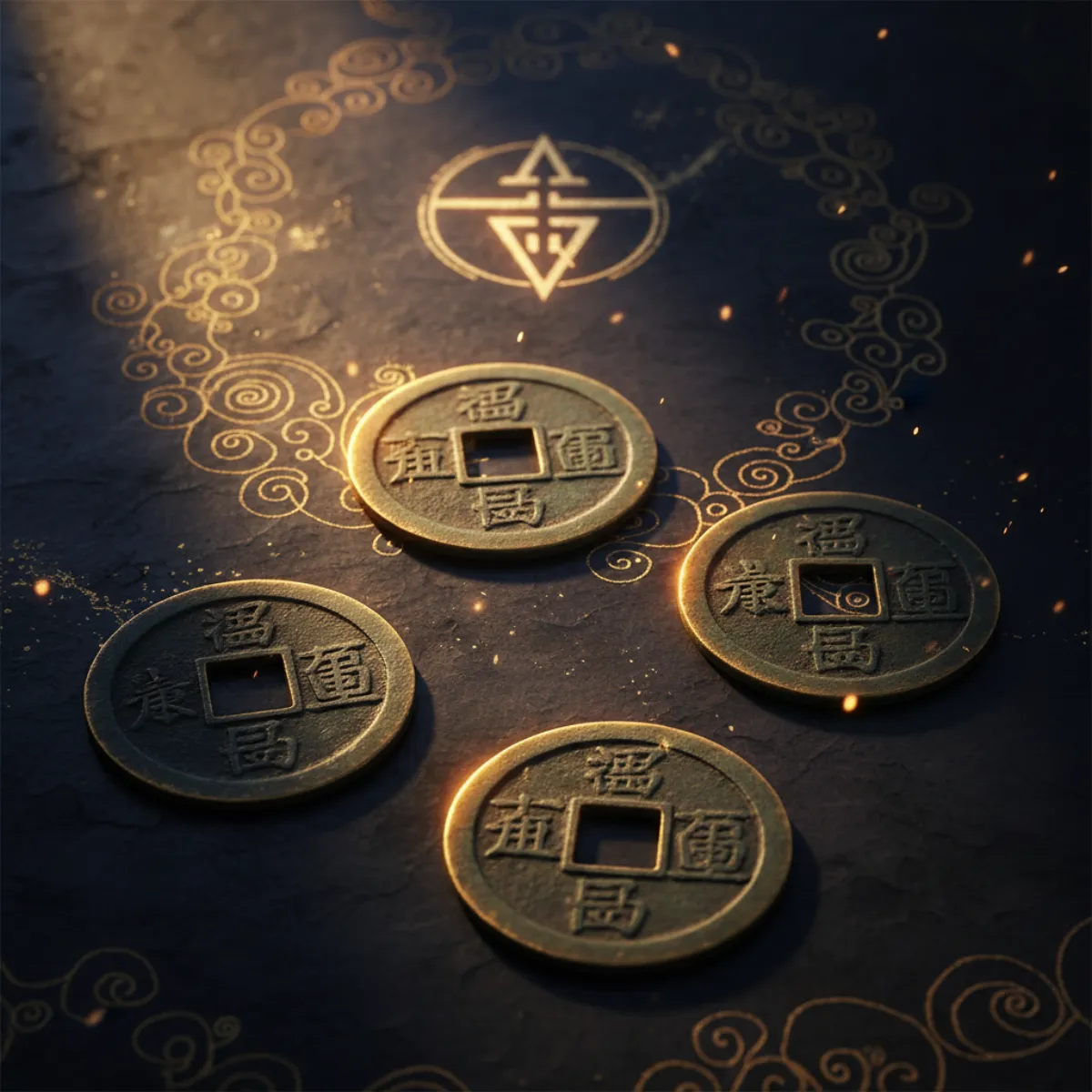
The I Ching (易经), the ancient Chinese Book of Changes, has guided people for over 3,000 years. What once needed a master scholar, yarrow stalks, and hours of ritual can now be done in minutes. You can do it online, for free, with AI-powered reading that rivals a professional session.
This guide walks you through the whole process. You’ll learn how to form your question, understand the coin toss, read your hexagram, and interpret changing lines. Whether you’re new to the I Ching or coming back after years, this is your starting point.
Get a free I Ching reading right now → YISHU INSIGHT
What Is the I Ching? A 60-Second Overview
The I Ching is a Chinese oracle text built around 64 hexagrams. Each hexagram is a pattern of six stacked lines. Each line is either solid (yang, —) or broken (yin, - -). Every hexagram stands for a life situation — creativity, waiting, conflict, progress, retreat, and more.
Unlike simple fortune-telling that says “yes” or “no,” the I Ching responds with metaphors, situations, and advice. It describes the nature of your current moment. It shows the forces at play and the wisest path forward.
The traditional method used yarrow stalks in an elaborate ritual. The most common modern method — and our focus here — is the simpler three-coin method. Digital tools can replicate this with excellent accuracy.
Step 1: Formulate Your Question
Your I Ching reading is only as good as your question. The oracle works best with sincere, open questions — not yes/no demands.
Good I Ching Questions:
- “What should I focus on in my relationship with [person] right now?”
- “What’s really going on with my career decision?”
- “What’s the best approach to [specific challenge] at this time?”
- “What am I not seeing about [situation]?”
- “What’s the likely direction if I pursue [path]?”
Less Effective Questions:
- “Will I get the job?” (too closed)
- “Is he/she cheating on me?” (accusatory, not open)
- “When will I be rich?” (too vague)
- Asking the same question again hoping for a better answer
The I Ching responds to your presence. Before you begin, take a moment to get still. Hold your question in mind — not as a demand, but as a genuine inquiry. The ancient practitioners called this “sincere heart” (诚心). It’s the key to a meaningful reading.
Step 2: The Coin Toss Method Explained
Here’s how the three-coin method works. You need three identical coins. Each side has a value:
- Heads = Yang = 3
- Tails = Yin = 2
Toss all three coins and add the values. You’ll get 6, 7, 8, or 9:
| Total | Line Type | Symbol |
|---|---|---|
| 6 | Old Yin (changing) | — × — (broken, moving to yang) |
| 7 | Young Yang (stable) | ——— (solid, unchanging) |
| 8 | Young Yin (stable) | — — (broken, unchanging) |
| 9 | Old Yang (changing) | ——— × (solid, moving to yin) |
Changing lines (6 and 9) are the key elements. They show:
- Which line in your hexagram is most active
- A second hexagram — created when you flip the changing lines to their opposite
Building Your Hexagram
You toss the coins six times. Build the hexagram from the bottom up. Line 1 is your first toss. Line 6 is the last. After six tosses, you have your primary hexagram. If any changing lines appeared, flip them to create your transformed hexagram.
Online Simulation
A good free I Ching tool does this digitally. It uses random number generation — just as random as physical coin tosses. This matters. The I Ching works with genuine randomness as a channel for meaning.
Cast your hexagram now with YISHU INSIGHT’s digital coin toss → I Ching Divination Tool
Step 3: Understanding Your Hexagram
Now you have your hexagram. Let’s read it. Every hexagram has several layers:
The Name and Image
Each hexagram has a name that captures its essence:
- Hexagram 1: Qian (☰☰) — The Creative — Pure yang energy. Strong, active, initiating force.
- Hexagram 2: Kun (☷☷) — The Receptive — Pure yin. Yielding, open, nurturing.
- Hexagram 3: Zhun — Difficulty at the Beginning — Chaos that comes before new growth.
- Hexagram 11: Tai — Peace — Heaven below, Earth above. An unusual but harmonious balance.
- Hexagram 29: Kan — The Abysmal (Water) — Danger and repeated challenge. Stay focused.
- Hexagram 36: Ming Yi — Darkening of the Light — Protect your inner light through hard times.
- Hexagram 49: Ge — Revolution — The old order overturned. Big change.
The Judgment (彖)
The Judgment is the core statement. It tells you what attitude or action fits this situation. For example, Hexagram 1 (The Creative): “The Creative works sublime success, furthering through perseverance.”
The Image (象)
The Image uses natural scenes — mountains, water, thunder, wind — to suggest how a wise person responds. It’s often a call to action: “Thus the superior person renews himself without ceasing.”
Line Texts (爻辞)
Each of the six lines has its own text. You only read a line’s text when it’s a changing line in your reading. These give targeted guidance for the part of your situation that’s actively shifting.
Step 4: Reading Changing Lines
Changing lines are the heart of I Ching divination. They tell you what’s moving — the threads of your situation that are actively shifting.
One Changing Line
Focus on that single line’s text. It speaks most directly to what’s happening. The transformed hexagram shows the likely outcome.
Two Changing Lines
Read both line texts. Your primary hexagram describes the current situation. Both changing lines show the active forces. The transformed hexagram shows where things resolve.
Three Changing Lines
Read all three, but give extra weight to the middle one. You can also focus more on the overall hexagram meanings (both primary and transformed) as your main guide.
No Changing Lines
Your primary hexagram stands as-is. Nothing is transforming. The situation is stable. Sometimes the I Ching is simply saying: no action needed. Just be steady.
All Six Lines Change
A complete transformation. Some readers focus on the transformed hexagram. Others sit with the meaning of total change itself — a radical shift in everything.
The 64 Hexagrams: A Brief Map
Knowing the broad landscape of the 64 hexagrams helps you place any reading. Here’s a quick map:
Hexagrams 1-8: Foundations — Creative force, receptivity, beginnings, inexperience, waiting, conflict, unity
Hexagrams 11-20: Social and Natural Dynamics — Peace, standstill, fellowship, possession, modesty, enthusiasm, following
Hexagrams 21-30: Character and Challenge — Biting through obstacles, grace, splitting apart, return, innocence, danger, clarity
Hexagrams 31-40: Influence and Movement — Influence, duration, retreat, power, progress, darkening, family, opposition, deliverance
Hexagrams 41-50: Refinement and Ascent — Decrease, increase, breakthrough, gathering, ascending, exhaustion, the well, revolution, the cauldron
Hexagrams 51-64: Completion and New Cycles — Thunder, mountain, gradual progress, abundance, the wanderer, wind, joy, limitation, inner truth, completion
Here’s the thing: the final hexagram is Hexagram 64, Wei Ji — Before Completion. The I Ching ends not with a finished state, but with the moment before completion. Why? Because change never stops. Every ending is a new beginning.
How AI Transforms I Ching Reading
The traditional I Ching text — even in great translations — can be cryptic. Classical Chinese is dense with metaphor. Applying ancient farming imagery to modern career questions takes years of practice.
AI-powered I Ching tools bridge this gap. A good AI reader:
- Gets your context — not just the hexagram, but how it connects to your question
- Blends all layers — primary hexagram, changing lines, transformed hexagram — into one clear story
- Speaks plainly while keeping the depth of the classical text
- Gives practical guidance — real steps, not vague platitudes
YISHU INSIGHT’s I Ching tool does exactly this. You enter your question, get a digitally cast hexagram, and receive a full AI reading that covers:
- The overall situation from your primary hexagram
- What the changing lines mean for your question
- The direction shown by the transformed hexagram
- Practical next steps
The reading is available in English, Japanese, and Chinese.
Get your free AI-powered I Ching reading → YISHU INSIGHT Divination
Tips for Getting the Most Accurate I Ching Reading
1. Ask One Clear Question
Don’t bundle questions. “Should I change jobs, and will my relationship improve?” is two questions in one. Pick the one that matters most right now.
2. Don’t Ask the Same Question Twice
If you don’t like the answer, resist the urge to try again. The I Ching is known for getting less clear when you ask the same thing over and over. Think of it as built-in protection against anxious seeking.
3. Record Your Readings
Keep a journal. Over time, patterns show up — certain hexagrams appearing again and again, the same changing lines popping up across different questions. This long-term view deepens your understanding a lot.
4. Sit With the Response
Unlike a horoscope you glance at and forget, an I Ching reading rewards reflection. Read the hexagram, then go for a walk or sleep on it. The meaning often gets clearer when you stop trying to force it.
5. Study the Classic Gradually
Even if you rely on a tool for readings, dip into the original text now and then. Reading it — even in translation — builds your feel for what each hexagram “sounds like.” The I Ching is, among other things, great literature.
Explore the Full I Ching Reference
Beyond personal readings, YISHU INSIGHT offers a complete 64 Hexagram Reference Database. You can look up any hexagram, study its structure, read all six line texts, and explore its meanings.
This is great for:
- Students learning the I Ching step by step
- Practitioners who want to cross-check their readings
- Anyone curious about why a certain hexagram keeps showing up
Explore all 64 hexagrams → I Ching Reference Library at YISHU INSIGHT
Conclusion: Ancient Wisdom, Modern Access
The I Ching has lasted 3,000 years because it works. Not by predicting a fixed future — but by reflecting the dynamics of your present moment with surprising accuracy. It works because it asks you to be present, honest, and open. It works because it speaks the language of change. And change is what life is made of.
Free I Ching readings online have never been easier or better than in 2026. Whether you’re at a crossroads, seeking clarity on a relationship, making a career move, or just curious — there’s never been a better time to start.
Your hexagram is waiting.
Start your free I Ching reading at YISHU INSIGHT → insightapp.life/zhouyi/divine
The I Ching says: “When you know yourself, you know the universe.” The first reading is just the beginning.