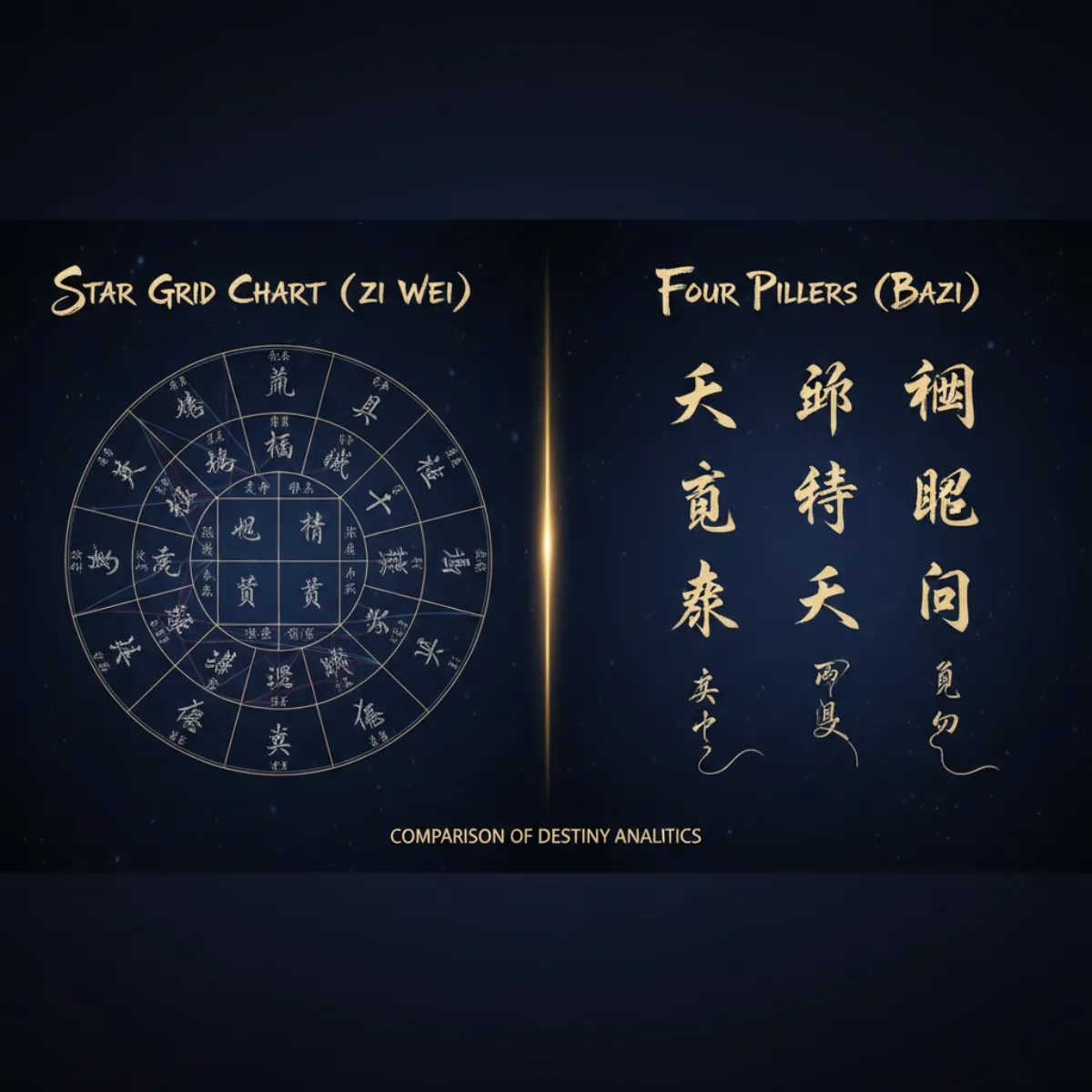
You’ve probably heard of BaZi. Maybe someone mentioned Zi Wei Dou Shu at a dinner party and you nodded politely. Both claim to decode your destiny from your birth time — so what’s actually different about them, and which one gives you better answers?
Here’s a straight comparison based on how each system works, what it’s good at, and when you’d pick one over the other.
Try it yourself: Generate your free Zi Wei Dou Shu chart at YISHU INSIGHT — no signup required.
What BaZi Actually Does
BaZi (八字), also called Four Pillars of Destiny, builds your chart from four pairs of Heavenly Stems and Earthly Branches — one pair each for your birth year, month, day, and hour. That gives you eight characters total (hence “eight characters” / 八字).
The system runs on Five Element theory. Your chart is essentially a map of how Wood, Fire, Earth, Metal, and Water interact at the moment you were born. A BaZi reader looks at which elements are strong, which are weak, and how they’ll shift across 10-year Luck Pillars and annual cycles.
BaZi excels at:
- Big-picture life direction — career aptitude, wealth potential, relationship patterns
- Identifying your strongest and weakest periods across decades
- Simple, logical framework — easier to learn and verify
- Understanding your core personality through elemental balance
Where BaZi falls short:
- Two people born in the same hour get identical charts. BaZi can’t distinguish between them without extra techniques.
- Pinpointing exactly when something happens within a year is harder — it works better at the decade and year level.
What Zi Wei Dou Shu Actually Does
Zi Wei Dou Shu (紫微斗数) — Purple Star Astrology — maps over 100 stars across 12 life palaces. Each palace governs a specific domain: career, wealth, relationships, health, parents, children, and so on.
The system originated with Chen Tuan (陈抟), a Taoist sage from the Song Dynasty. Legend says it was reserved for emperors — the “Emperor’s Astrology” (帝王学). Whether or not that’s historically accurate, it hints at the system’s granularity.
Zi Wei Dou Shu excels at:
- Detailed, event-level predictions — not just “good year” but which month and what kind of event
- Mapping 12 distinct life areas simultaneously (career palace, spouse palace, wealth palace, etc.)
- Distinguishing between people born at the same time through star arrangement variations
- The Four Transformations (四化) system for tracking annual and decade-level shifts
Where it falls short:
- Steep learning curve — 14 main stars, 100+ minor stars, 12 palaces, multiple transformation layers
- More room for subjective interpretation, which means reader skill matters enormously
- Less widely practiced outside Chinese-speaking communities, so finding a good reader is harder
Head-to-Head: 7 Key Differences
1. Precision Level
BaZi paints in broad strokes — think “weather forecast for the decade.” Zi Wei Dou Shu zooms in — think “what’s happening this March in your career.”
2. Birth Data Sensitivity
Both need year, month, day, and hour. But Zi Wei Dou Shu’s star placements shift with finer time divisions, making it slightly more sensitive to birth time accuracy. If you only know you were born “around noon,” BaZi is more forgiving.
3. Number of Variables
BaZi works with 10 Heavenly Stems + 12 Earthly Branches + 5 Elements. That’s elegant and constrained. Zi Wei Dou Shu juggles 14 main stars + 100+ auxiliary stars + 12 palaces + Four Transformations. More data, more nuance, more complexity.
4. Learning Curve
A motivated person can start reading basic BaZi charts in a few weeks. Zi Wei Dou Shu typically takes months to years before you’re comfortable with interpretations.
5. Career & Relationship Advice
Both systems address these areas. BaZi tells you which element supports your career (e.g., “Water industries suit you”). Zi Wei Dou Shu names specific star combinations in your Career Palace that suggest how your professional life unfolds — leadership style, workplace dynamics, timing of promotions.
6. Annual Forecasting
BaZi’s annual pillar interacts with your natal chart to show the year’s general energy. Zi Wei Dou Shu’s Annual Chart (流年盘) overlays new star positions onto your natal palaces, giving month-by-month granularity.
7. Cultural Reach
BaZi is mainstream across East and Southeast Asia. Zi Wei Dou Shu has a passionate following in Taiwan, Hong Kong, and increasingly in Singapore and Malaysia, but remains niche in Japan, Korea, and the West.
So Which One Should You Choose?
Pick BaZi if:
- You want a clear, logical framework for understanding your life direction
- You’re just getting started with Chinese metaphysics
- Your birth time isn’t precisely known
- You prefer strategic, big-picture guidance
Pick Zi Wei Dou Shu if:
- You want detailed, specific predictions about timing and events
- You know your exact birth time (ideally to the minute)
- You’re willing to invest time learning or finding a skilled reader
- You want insights across multiple life domains simultaneously
Or — use both. Experienced practitioners often cross-reference BaZi and Zi Wei Dou Shu. BaZi shows the underlying elemental energy; Zi Wei Dou Shu shows how that energy manifests as specific events and relationships. They’re complementary, not competing.
How YISHU INSIGHT Handles This
Our Zi Wei Dou Shu charting tool generates your full natal chart instantly — 14 main stars, all 12 palaces, Four Transformations included. You can also check your annual fortune (流年) to see what this year’s star movements mean for you.
For Zhou Yi / I Ching readings, try our divination tool — it’s a different system entirely, but pairs beautifully with both BaZi and Zi Wei Dou Shu for decision-making.
Common Questions
Q: Is Zi Wei Dou Shu more accurate than BaZi? Neither is inherently “more accurate.” Zi Wei Dou Shu offers finer detail; BaZi provides clearer structural analysis. Accuracy depends heavily on the practitioner’s skill and your birth time precision.
Q: Can I use both systems at the same time? Absolutely. Many professional readers do exactly this — BaZi for the macro view, Zi Wei Dou Shu for the micro. When both systems point to the same conclusion, confidence goes up significantly.
Q: Do I need my exact birth minute for Zi Wei Dou Shu? The hour is essential. The exact minute helps with advanced techniques but isn’t strictly required for a standard chart. If you’re unsure about your birth hour, start with BaZi — it’s more tolerant of approximation.
Curious about your own chart? Generate your free Zi Wei Dou Shu natal chart →