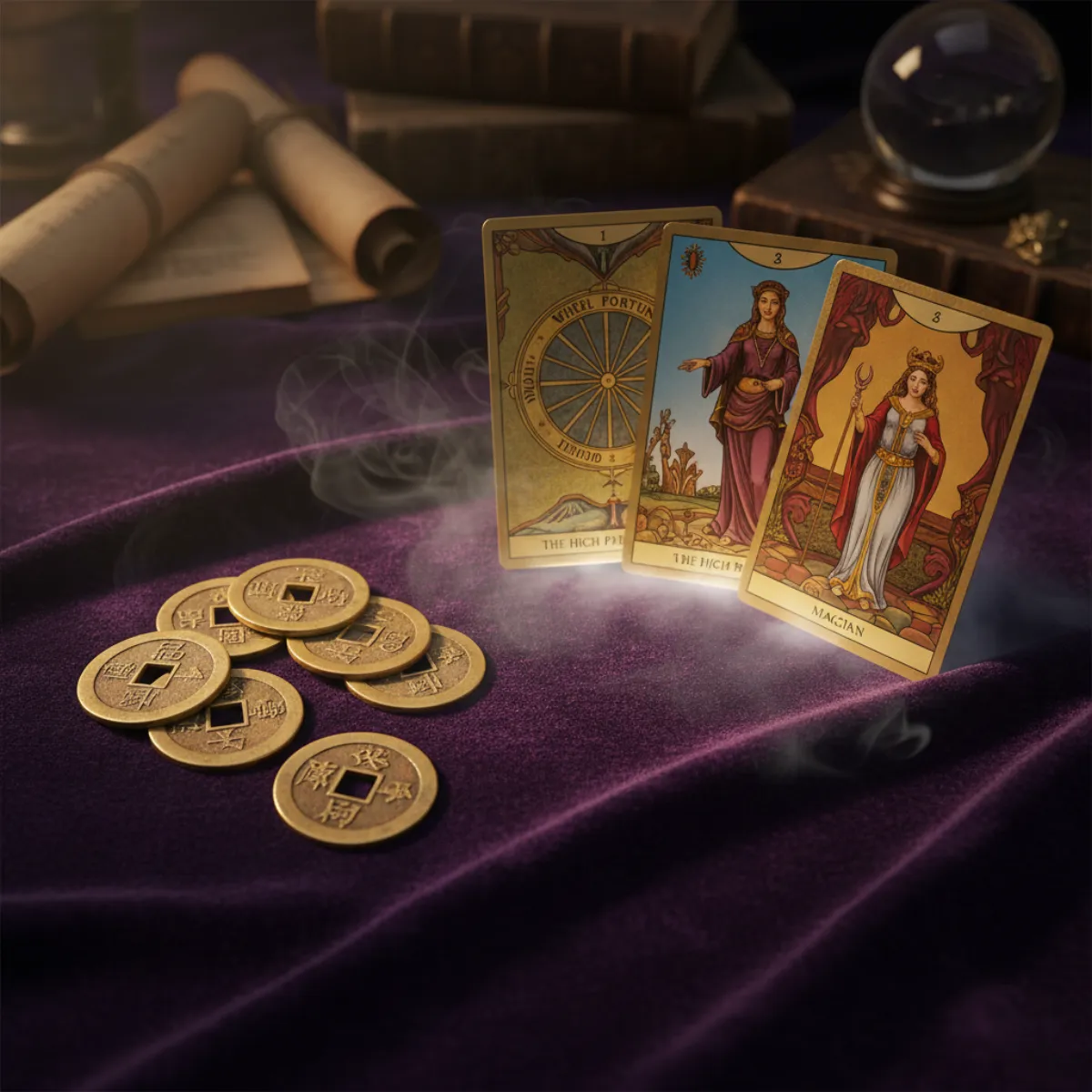
Both I Ching and Tarot have guided seekers for centuries. Both offer insight into the present moment. Both can reveal hidden dynamics and point toward possible futures. Yet these two systems are very different in how they work and what kind of wisdom they offer.
Trying to decide between the ancient Chinese oracle and the Western card deck? This guide will help. You’ll learn what each system does best — and which one fits you.
Try free I Ching divination online → YISHU INSIGHT
A Tale of Two Ancient Systems
The I Ching: 3,000 Years of Continuous Use
The I Ching (易经), or Book of Changes, is one of the oldest texts in human history. Its roots go back to ancient China. The core structure comes from King Wen of the Zhou dynasty (around 1000 BCE). The 64 hexagrams — patterns of six broken (yin) and unbroken (yang) lines — form the backbone of the system.
What makes the I Ching special is its depth. It’s not just a fortune-telling tool. It’s a complete framework for how the universe works. Everything flows through yin and yang — expansion and contraction, stillness and movement. The Ten Wings (texts linked to Confucius) turned the I Ching from a divination manual into a work of philosophy.
The I Ching has shaped Chinese culture for three thousand years. It influenced Taoism, Confucianism, traditional medicine, military strategy, and even modern math. Leibniz famously connected binary arithmetic to the hexagram system.
Tarot: Medieval Mystery Cards
Tarot cards first appeared in 15th-century northern Italy as playing cards for games like tarocchi. People started using them for divination later. Structured occult Tarot grew in the 18th and 19th centuries. French occultists like Antoine Court de Gébelin and Etteilla connected the cards to Kabbalah and Hermetic symbolism.
The modern Rider-Waite-Smith deck (1909) became the template for most Tarot decks today. Pamela Colman Smith illustrated it under Arthur Edward Waite’s direction. Its rich images — each card showing a specific scene — make Tarot easy to read by intuition.
Today’s Tarot deck has 78 cards. There are 22 Major Arcana (big themes from The Fool to The World) and 56 Minor Arcana (four suits covering everyday life).
How Each System Works
I Ching: The Mathematics of Change
I Ching divination starts with a question held firmly in mind. Then you generate a hexagram through chance. Traditionally, people divided and counted 50 yarrow stalks in a ritual process. Today, the most common method uses three coins.
Each coin toss gives you a yin or yang line. When all three coins show the same face, you get a “changing” line. Six tosses create a hexagram — one of 64 possible patterns. If any changing lines appear, a second hexagram is produced.
Here’s how you read the result:
- Interpret the primary hexagram’s overall meaning
- Read the specific “changing” lines
- Interpret the transformed hexagram as the likely outcome
The 64 hexagrams cover a huge range of human situations. You’ll find “Creative Force” (Hexagram 1), “Exhaustion” (Hexagram 47), “Revolution” (Hexagram 49), and “After Completion” (Hexagram 63). The language is rich with metaphor — river crossings, advancing armies, the sage’s conduct.
Cast your free I Ching hexagram → YISHU INSIGHT I Ching Tool
Tarot: The Gallery of Archetypes
Tarot reading starts with shuffling the deck while you focus on a question. Then you draw cards and lay them in a spread — a pattern where each position has meaning. Common spreads include:
- Single card: Quick daily guidance
- Three-card spread: Past, present, future (or situation, action, outcome)
- Celtic Cross (10 cards): A full overview of your situation
Then you interpret each card in its position. You consider:
- The card’s traditional meaning
- Whether it’s upright or reversed (flipped)
- How the cards relate to each other
- Your gut feelings about the images
Unlike the I Ching’s text-based tradition, Tarot relies on visual symbols and intuition. The images — a blindfolded figure with two swords, a tower struck by lightning, the hermit on a mountain — speak straight to your deeper mind.
Strengths and Weaknesses
Where the I Ching Excels
Deep philosophy: The I Ching gives you more than an answer. It gives you a worldview. Every reading places your question within the larger flow of natural cycles — change, timing, and knowing when not to force things.
Timing insights: “Changing lines” and the transformed hexagram show where things are heading. You don’t just see where you stand. You see where you’re going.
Calm neutrality: The I Ching has no dramatic imagery. No skulls, no towers. Its language draws from nature, leadership, and ethics. This makes readings less emotionally charged than some Tarot sessions.
Rich commentary: Centuries of scholars and practitioners have built a deep tradition around each hexagram. From Confucius to Wilhelm to Cleary — there’s a wealth of insight to draw from.
Weaknesses: The classical language can feel hard to grasp. Without good translation, it’s easy to misread. The hexagrams don’t give you one clear sentence. They ask you to sit, think, and apply the wisdom to your own situation.
Where Tarot Excels
Easy to start: Tarot’s pictures make it intuitive from day one. Even before you study every card’s meaning, the images give you a starting point.
Emotional depth: The Major Arcana — The High Priestess, The Lovers, Death, The Star — tap directly into feelings and inner states. The I Ching’s nature metaphors don’t always hit as personally.
Variety: With 78 cards, many spreads, and reversals, Tarot offers huge variety. Every reading feels fresh.
Inner mirror: Modern Tarot readers, inspired by Jung, use cards as mirrors of the unconscious. It’s a tool for self-awareness and inner dialogue — not just prediction.
Weaknesses: Meaning can be very subjective. Two readers looking at the same spread may give different answers. The system also lacks a single core text like the I Ching’s canon.
Which Questions Does Each Answer Better?
Ask the I Ching When:
- You need guidance on timing — act now or wait?
- You’re facing a big decision with long-term impact
- You want to understand what’s really going on beneath the surface
- You’re drawn to Taoist or Confucian thinking
- You prefer a thoughtful, text-based process
- Your question is about business, career, or major life changes
Ask Tarot When:
- You need to explore your feelings about something
- You want quick flashes of insight
- The question is about relationships and emotions
- You’re working through something unconscious and want to bring it to light
- You enjoy visual, image-based thinking
- You want a tool for daily check-ins and self-reflection
The Cultural Dimension
It’s worth noting that I Ching and Tarot come from very different cultures. This shapes what each one does best.
The I Ching grew from a culture that valued natural cycles, social order, and collective harmony. Its questions often deal with timing, right conduct, and going with the larger flow. The hexagram names — “Following,” “Obstruction,” “The Well,” “Return” — show a worldview where people exist within nature and society.
Tarot emerged from Western Europe — a culture shaped by individual journeys, mystical traditions, and inner exploration. The Major Arcana trace a Hero’s Journey. The naive Fool sets out, faces trials, and becomes the integrated World dancer. This arc speaks to the Western idea of one person seeking meaning.
Neither system is “better.” They light up different parts of human experience.
Can You Use Both?
Yes! Many serious practitioners use both. They apply each where it’s strongest:
- Use the I Ching for strategic questions about timing and flow
- Use Tarot for inner work, emotional clarity, and self-understanding
- Use both for major decisions — let each system offer its own view
Some practitioners even combine the two. They treat the hexagram as a structural framework and the cards as emotional detail within it.
Modern Tools: AI-Enhanced Divination
One barrier to I Ching reading has always been the hard-to-read classical text. Modern AI changes this. YISHU INSIGHT offers free I Ching divination with AI-powered reading that:
- Generates your hexagram from a virtual coin toss
- Finds your primary and transformed hexagrams
- Gives deep, context-aware reading of changing lines
- Applies the result to your specific question in plain language
- Supports English, Japanese, and Chinese
The result? An I Ching reading as rich as a session with an expert — available anywhere, anytime.
Try AI-powered I Ching divination → YISHU INSIGHT Divination Tool
The Verdict: Which Is Right for You?
Choose I Ching if:
- You’re drawn to Eastern philosophy and want depth in your divination
- You want substance over speed
- Your questions lean toward strategy, timing, and ethics
- You’re willing to sit with a hexagram and reflect on its layers
Choose Tarot if:
- You’re drawn to visual symbols and archetypes
- You value emotional resonance and inner insight
- You want a system that clicks right away
- You enjoy the creativity of card spreads
Choose both if:
- You’re a committed seeker who values every tool for self-understanding
- You see that different systems light up different sides of reality
The best divination system is the one you keep coming back to with real curiosity. These tools work not by revealing hidden futures. They work by giving you a framework to access wisdom you already carry.
Whatever system you choose, it all comes down to your question. A sincere, specific, open-minded question to either oracle will always return more insight than a vague or resistant one.
Begin your I Ching journey today → Free I Ching reading at YISHU INSIGHT