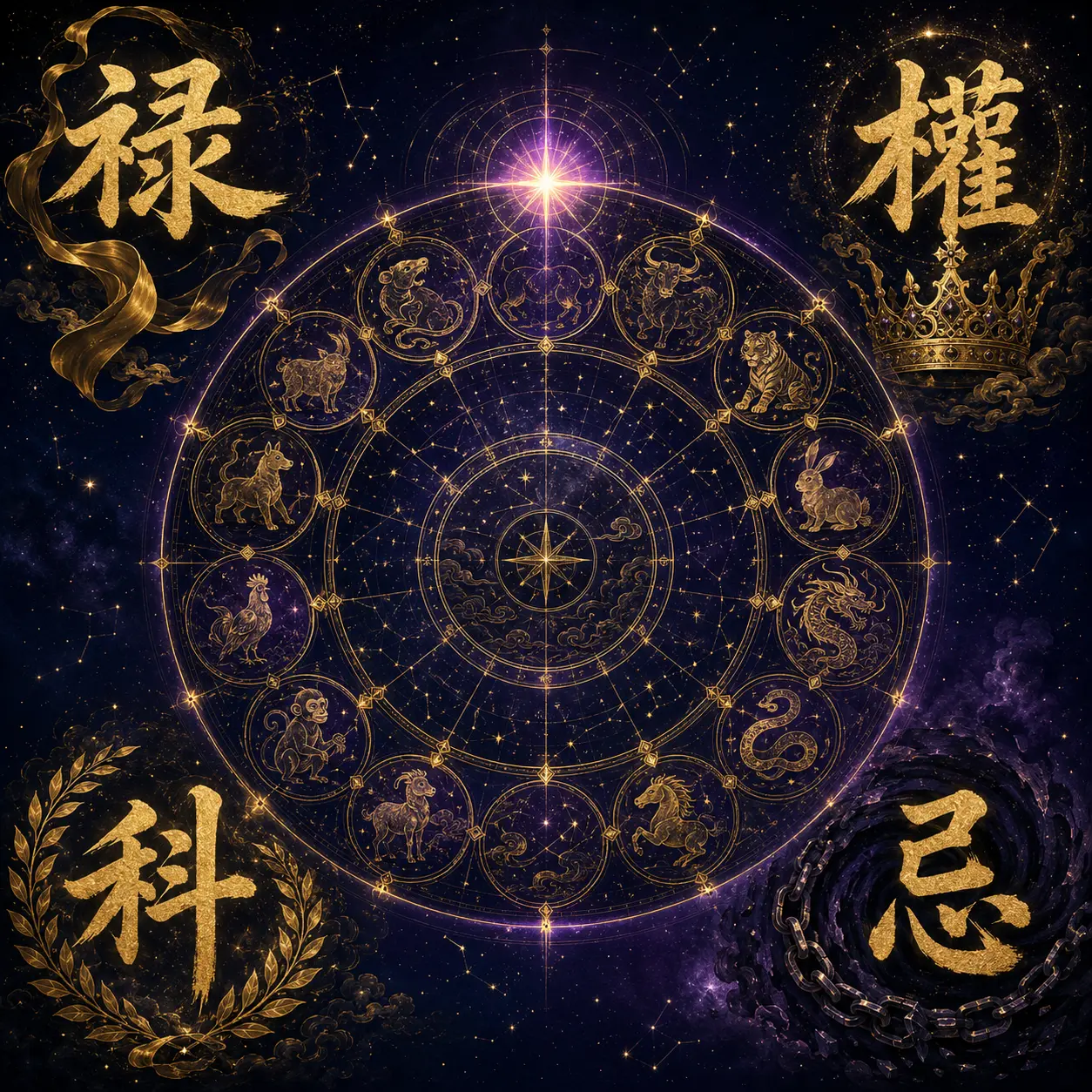
If Zi Wei Dou Shu (紫微斗数) is a map of 100+ stars across 12 life palaces, then Si Hua (四化) — the Four Transformations — is the lighting that tells you which parts of the map are bright, which are charged, which are spotlighted, and which are jammed.
You can read a Zi Wei chart without Si Hua, the same way you can read a city map without traffic data. It just won’t tell you what’s actually flowing today. This guide walks through what each of the four transformations means, how they’re cast, and how decade and annual Si Hua reshape your reading.
See your Si Hua live: generate your Zi Wei chart at YISHU INSIGHT — Si Hua placements are computed automatically.
What Si Hua Actually Is
In Zi Wei Dou Shu, Si Hua literally means “Four Transformations.” Four of the 14 main stars in your natal chart receive a transformation flag based on the Heavenly Stem (天干) of your birth year. The four transformations are:
| Transformation | Chinese | Quality | What it does |
|---|---|---|---|
| Hua Lu | 化禄 | Prosperity / Flow | Brings ease, income, opportunity, connection |
| Hua Quan | 化权 | Power / Authority | Adds decisiveness, control, leadership |
| Hua Ke | 化科 | Fame / Help | Brings reputation, mentors, recognition |
| Hua Ji | 化忌 | Obstruction / Attachment | Creates blockage, fixation, lessons |
Each transformation lands on one specific star, and that star sits inside one specific palace (career, wealth, marriage, etc.) in your chart. The combination — which star gets the transformation and which palace it falls in — is where Si Hua delivers most of its diagnostic power.
The Four Transformations in Detail
Hua Lu (化禄) — Prosperity, Flow
The star carrying Hua Lu becomes a channel for abundance and ease. Income, opportunities, social connections, romantic interest, and creative output all flow more readily through whatever life domain that star governs in your chart.
If your Wealth Palace carries Hua Lu, money tends to come without forcing it — clients show up, side income emerges, asset appreciation happens. If your Spouse Palace carries Hua Lu, you draw partners with relative ease. If your Career Palace carries Hua Lu, work feels like flow rather than grind.
Lu is what comes to you — receptive, abundant, expansive.
Hua Quan (化权) — Power, Authority
The star carrying Hua Quan gains decisiveness, control, and managerial energy. The life domain that star governs becomes a place where you are in charge — making the calls, holding the resources, leading the team.
A Career Palace with Hua Quan suggests you’ll be in roles where authority matters — managing people, owning the strategy, being held accountable for outcomes. A Wealth Palace with Hua Quan suggests active management of money rather than passive flow — entrepreneurship, investments, deals.
Quan is what you control — assertive, structured, leadership-flavored.
Hua Ke (化科) — Fame, Help, Recognition
The star carrying Hua Ke attracts mentors, supporters, public visibility, and academic / professional reputation. The life domain it governs becomes a place where you’re seen, helped, and recognized.
A Career Palace with Hua Ke often shows up as professional reputation, awards, published work, or a track record people remember. The Parent Palace with Hua Ke often points to influential mentors or family support. Hua Ke is also classically associated with examinations, qualifications, and credentials.
Ke is how you’re seen and supported — recognition, allies, mentorship.
Hua Ji (化忌) — Obstruction, Attachment, Lessons
The hardest of the four to interpret. Hua Ji literally means “transforms into obstruction” or “into fixation.” The star carrying Hua Ji becomes a point of stuckness, attachment, or repeated lesson in your life.
This is not purely negative. Hua Ji marks the area where you’ll do the deepest learning — but it also marks where you’ll feel pinned down, frustrated, or attached beyond reason. A Spouse Palace Ji can point to repeated relationship struggles; a Career Palace Ji can mark obsessive ambition or chronic friction at work.
The classical advice: face Ji directly. Suppression makes it worse; conscious engagement transforms it into your most developed area over the long term.
Ji is where you’re locked in — fixation, friction, deep work.
How Si Hua Is Cast: The Year Stem Rule
Si Hua is not random. It’s determined by the Heavenly Stem of your birth year — the first character of your year’s 干支 (stem-branch) pair. There are 10 stems, and each stem maps to a fixed quartet of stars receiving Lu, Quan, Ke, Ji respectively.
According to the classical Zi Wei tradition, the mapping is:
| Year Stem | Hua Lu | Hua Quan | Hua Ke | Hua Ji |
|---|---|---|---|---|
| 甲 (jiǎ) | 廉贞 Lian Zhen | 破军 Po Jun | 武曲 Wu Qu | 太阳 Tai Yang |
| 乙 (yǐ) | 天机 Tian Ji | 天梁 Tian Liang | 紫微 Zi Wei | 太阴 Tai Yin |
| 丙 (bǐng) | 天同 Tian Tong | 天机 Tian Ji | 文昌 Wen Chang | 廉贞 Lian Zhen |
| 丁 (dīng) | 太阴 Tai Yin | 天同 Tian Tong | 天机 Tian Ji | 巨门 Ju Men |
| 戊 (wù) | 贪狼 Tan Lang | 太阴 Tai Yin | 太阳 Tai Yang | 天机 Tian Ji |
| 己 (jǐ) | 武曲 Wu Qu | 贪狼 Tan Lang | 天梁 Tian Liang | 文曲 Wen Qu |
| 庚 (gēng) | 太阳 Tai Yang | 武曲 Wu Qu | 太阴 Tai Yin | 天同 Tian Tong |
| 辛 (xīn) | 巨门 Ju Men | 太阳 Tai Yang | 文曲 Wen Qu | 文昌 Wen Chang |
| 壬 (rén) | 天梁 Tian Liang | 紫微 Zi Wei | 左辅 Zuo Fu | 武曲 Wu Qu |
| 癸 (guǐ) | 破军 Po Jun | 巨门 Ju Men | 太阴 Tai Yin | 贪狼 Tan Lang |
(Note: minor school-by-school variations exist — particularly for the 戊 and 庚 rows in non-mainstream traditions. The table above reflects the most widely used modern standard.)
If you’re born in 1990 (year stem 庚 gēng), Tai Yang gets Lu, Wu Qu gets Quan, Tai Yin gets Ke, Tian Tong gets Ji. Wherever those stars sit in your 12 palaces, that’s where the four transformations land.
Beyond Birth: Decade Si Hua and Annual Si Hua
Your natal Si Hua (本命四化) — the one cast from your year stem — is permanent. But Zi Wei layers two more cycles on top:
Decade Si Hua (大限四化)
Every 10 years, you enter a new Da Xian (大限) — a decade palace that becomes the dominant frame for that life chapter. The Heavenly Stem of that decade palace casts a fresh set of Si Hua, layered over your natal pattern.
This means: a star that’s quiet in your natal chart can suddenly become a Lu, Quan, Ke, or Ji during a particular decade — and the experience of those 10 years is heavily flavored by which star and which palace lights up.
Annual Si Hua (流年四化)
Each year has its own Heavenly Stem. The Si Hua cast from the current year’s stem overlays your chart for that calendar year. This is what makes Zi Wei capable of month-by-month, year-by-year fortune reading — the annual Si Hua tells you which stars are activated this year, on top of your natal and decade patterns.
See your annual Si Hua applied to this year’s chart →
Reading Si Hua in Practice
A few patterns experienced readers look for:
1. Self-Si Hua (自化) — when a transformation lands on a star inside the palace it activates from. This often signals self-driven energy in that domain — both the good (initiative, ownership) and the difficult (self-undermining loops).
2. Si Hua across paired palaces — Zi Wei has six “axis” pairs (e.g., 命宫 Self ↔ 迁移 Travel, 财帛 Wealth ↔ 福德 Fortune). When Si Hua lands on opposite ends of an axis, the two palaces actively dialogue.
3. The Lu-Quan-Ke triangle vs. Ji — Lu, Quan, and Ke are generally constructive; Ji is the friction point. A common reading practice is to identify which palace gets Ji and whether any of the constructive transformations land in palaces that “support” the Ji palace.
4. Decade Ji landing on natal Lu palace — a classic indicator of “good fortune turning sticky” during that decade. Conversely, decade Lu on a natal Ji palace can mark a breakthrough decade for an area that’s been stuck.
For broader context on the 12 palaces themselves, see Zi Wei Dou Shu 12 palaces explained.
Common Misreadings
Treating Hua Ji as “bad luck.” Ji creates depth, not catastrophe. Most successful people have Ji on whatever they’ve poured 10,000 hours into. The friction is the practice.
Treating Hua Lu as “I’ll be rich.” Lu is flow, not magnitude. It tells you the channel is open; it does not guarantee scale. Quan + Lu together is closer to “scaled prosperity,” and even that requires real-world effort.
Reading natal Si Hua and ignoring decade. A natal chart describes potential. Decade Si Hua describes which potential is being activated right now. Reading only the natal layer is like reading the rules of chess and ignoring the current board.
Confusing transformation flags with star nature. Zi Wei (紫微) is a regal, leadership-tilted star. With Hua Quan, that quality intensifies; with Hua Ji, it can twist into rigid authoritarianism. The transformation modifies the star’s character — it doesn’t replace it.
How to Use This in a Real Reading
A practical 3-step:
- Identify your year stem and look up your natal Si Hua quartet. Note which palaces those four stars sit in.
- Identify your current decade palace (Da Xian) and look up its Si Hua. Note which palaces those four land in for the current 10-year window.
- Identify the current year’s stem and look up its Si Hua. Apply this for short-term forecasting on top of layers 1 and 2.
Where multiple layers stack on the same palace — for example, natal Lu + decade Ke + annual Quan — that palace is significantly energized this year. Where multiple Ji stack on one palace, that’s a focused friction point demanding attention.
Common Questions
Q: Do all 14 main stars get a Si Hua? No. Each year stem activates exactly four stars — one each for Lu, Quan, Ke, Ji. The other 10 main stars sit unmarked. Auxiliary stars (Wen Chang, Wen Qu, Zuo Fu, etc.) can also receive Si Hua under certain stems.
Q: Can a star have two Si Hua at once? Yes — when natal, decade, and annual Si Hua stack, the same star can carry multiple transformation flags simultaneously. Reading these layered cases is one of the more advanced skills in Zi Wei.
Q: Is the 戊 / 庚 row controversial? Mildly. Different schools place the Ji slightly differently in those two rows. Most contemporary practitioners use the standard table shown above. If you’re working with a traditional teacher, check which lineage they follow.
Q: I’m new to Zi Wei. Is Si Hua advanced? Si Hua is intermediate. Beginners should first absorb the 14 main stars and the 12 palace meanings. Once you can read a chart at the palace+star level, layering Si Hua adds the dynamism that turns Zi Wei from a static description into a working forecasting tool.
Curious where your Si Hua actually land? Generate your free Zi Wei Dou Shu chart → and check the four transformations on your natal palaces.