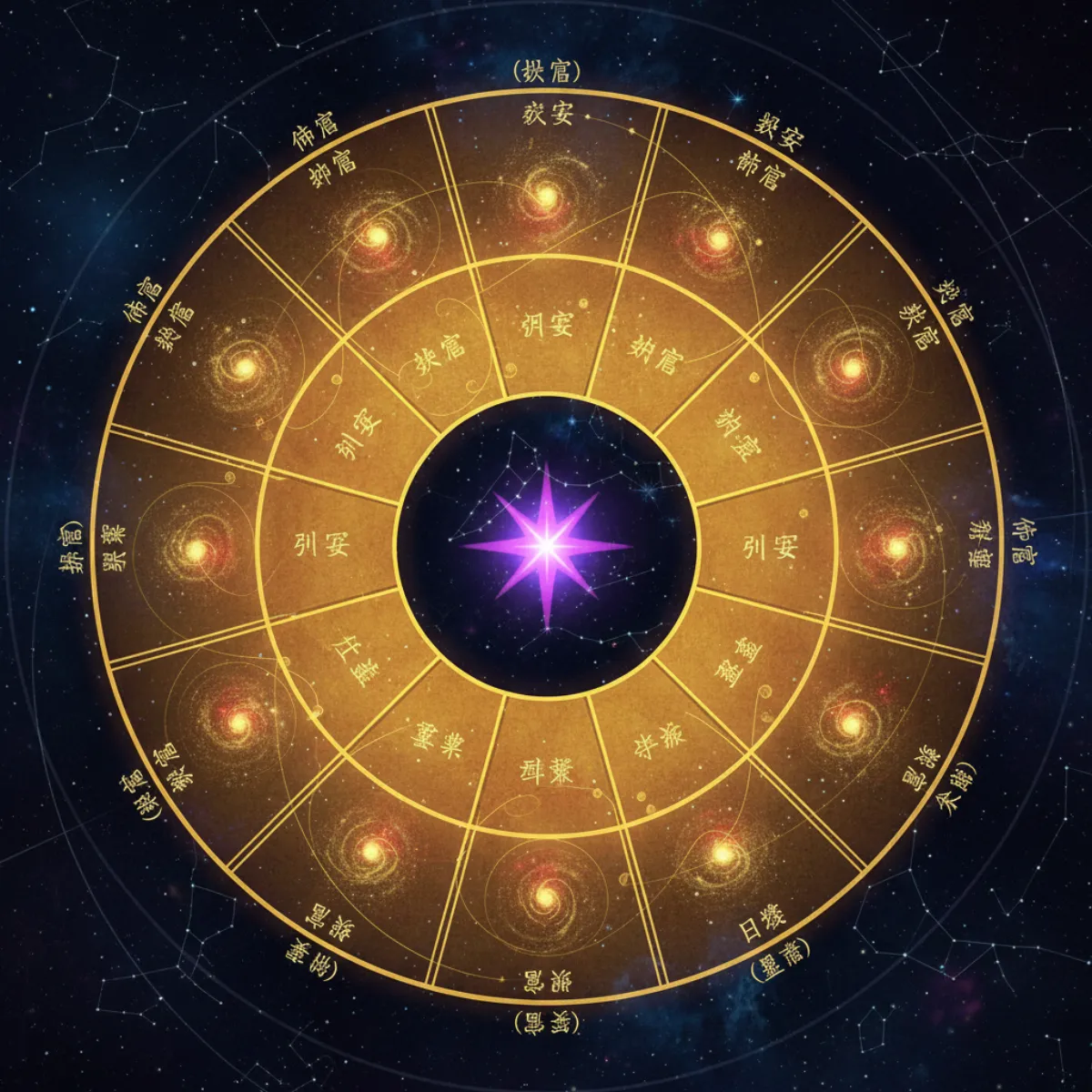
Your Zi Wei Dou Shu chart is a circular map divided into 12 sectors — each one a palace (宫, gōng) governing a specific domain of your life. Think of them as 12 windows: career, relationships, money, health, spirituality, and more. The stars that land in each palace shape how that area of life unfolds for you.
If you’re new to this system, our beginner’s guide to Zi Wei Dou Shu covers the foundations. Already familiar with the basics? This article walks through all 12 palaces of Zi Wei Dou Shu one by one — what each palace means, which stars to watch, and how to make a quick favorable-or-challenging read.
Ready to follow along with your own chart? Generate your free Zi Wei Dou Shu chart here and keep it open as you read.
1. Life Palace (命宫 Mìng Gōng) — Who You Are
The Life Palace is the anchor of the entire chart. It represents your core personality, temperament, and the overarching theme of your life. Every other palace radiates from this center.
What to look for:
- The main star (主星) sitting here defines your fundamental character. Zi Wei (Emperor) star here suggests leadership and dignity; Tian Ji (Heavenly Secret) suggests quick thinking and adaptability.
- Hua Lu (化禄) flying into this palace brings natural ease and charm. Hua Ji (化忌) brings inner tension that drives growth.
- An empty Life Palace (no main star) isn’t bad — it means you borrow stars from the opposite palace (Migration Palace), making you adaptable and influenced by your environment.
Quick read: Auspicious stars here → strong sense of self, clear life direction. Challenging stars → more internal struggle, but often deeper personal development.
2. Siblings Palace (兄弟宫 Xiōng Dì Gōng) — Your Closest Allies
This palace governs siblings, close colleagues, and cooperative relationships. In modern readings, it extends to business partners and your immediate peer group.
What to look for:
- Tian Fu (Treasury) or Tian Xiang (Minister) here indicates supportive, reliable siblings or partners.
- Qisha (Seven Killings) or Po Jun (Army Breaker) suggests competitive or independent dynamics among peers.
- This palace also hints at your ability to collaborate — strong stars mean you work well in teams.
Quick read: Benefic stars → harmonious sibling/peer relationships, strong support network. Malefic stars → tensions in partnerships, better working independently.
3. Spouse Palace (夫妻宫 Fū Qī Gōng) — Love and Marriage
The Spouse Palace reveals the nature of your romantic relationships and marriage. It describes your ideal partner’s qualities and how your love life unfolds.
What to look for:
- Tian Liang (Heavenly Beam) suggests a caring, older-soul partner. Tan Lang (Greedy Wolf) brings passionate, magnetic romance — sometimes complicated.
- Wen Chang or Wen Qu (literary stars) here indicate an intellectual or artistic connection with your spouse.
- Hua Ji in this palace often points to emotional entanglements or a relationship that requires significant effort.
Quick read: Gentle, benefic stars → smooth romantic life, supportive partner. Intense stars (Qisha, Po Jun, Tan Lang) → passionate but turbulent love, often with dramatic turning points.
4. Children Palace (子女宫 Zǐ Nǚ Gōng) — Offspring, Romance, and Creativity
Despite its name, this palace covers more than children. It governs your relationship with your kids, romantic affairs (peach blossom luck), and investment/speculative ventures.
What to look for:
- Zi Wei or Tian Fu here suggests talented, capable children and good investment instincts.
- Tan Lang (Greedy Wolf) in this palace amplifies romantic encounters — you may attract admirers easily.
- Huo Xing (Fire Star) or Ling Xing (Bell Star) can indicate impulsive investments or sudden romantic sparks.
Quick read: Auspicious stars → fulfilling relationship with children, lucky in romance and investments. Challenging stars → need caution with speculative ventures, possible complications in romantic affairs.
5. Wealth Palace (财帛宫 Cái Bó Gōng) — Money and Financial Style
The Wealth Palace shows how you earn money, your relationship with finances, and your capacity for accumulating wealth. It’s less about how much you’ll earn and more about your financial style.
What to look for:
- Wu Qu (Military Star) here is one of the strongest wealth indicators — disciplined, finance-oriented.
- Tian Fu (Treasury) brings steady accumulation. Lu Cun (Salary Star) indicates reliable income streams.
- Po Jun (Army Breaker) in the Wealth Palace suggests volatile finances — big wins and big losses.
Quick read: Stable wealth stars → consistent income, good at saving. Dynamic stars → higher earning potential but with more financial ups and downs. The key is matching your strategy to your chart’s energy.
6. Health Palace (疾厄宫 Jí È Gōng) — Body and Vulnerability
This palace reveals physical constitution, health vulnerabilities, and potential chronic issues. Traditional readings use it to identify which organ systems need attention.
What to look for:
- Lian Zhen (Purity Star) here may indicate issues with the urinary or reproductive system.
- Ju Men (Giant Gate) can point to digestive or oral health concerns.
- Tian Tong (Heavenly Unity) in a weakened state may suggest low energy or emotional health challenges.
Quick read: Strong benefic stars → robust constitution. Malefic stars or Hua Ji → specific vulnerabilities to monitor. This palace is best used for prevention, not prediction of illness.
7. Migration Palace (迁移宫 Qiān Yí Gōng) — The Outside World
The Migration Palace governs your experiences outside the home — travel, relocation, social image, and encounters with helpful people (贵人). It’s the “external self” that complements the Life Palace’s “internal self.”
What to look for:
- Zi Wei or Tian Liang here attracts noble helpers wherever you go.
- Tian Ma (Heavenly Horse) amplifies travel and movement — frequent relocations or a mobile lifestyle.
- This palace directly opposes the Life Palace, so the stars here show what the world sees in you and what opportunities come from being “out there.”
Quick read: Auspicious stars → thriving in new environments, strong social reputation, helpful connections abroad. Challenging stars → difficulties when traveling or relocating, better staying close to home.
8. Friends Palace (交友宫 Jiāo Yǒu Gōng) — Social Circle and Subordinates
Historically called the Servants Palace (奴仆宫), this palace now represents your broader social network, friendships, employees, and subordinates.
What to look for:
- Tian Xiang (Minister) or Zuo Fu / You Bi (Left and Right Assistants) here means loyal friends and capable subordinates.
- Qisha or Tan Lang may indicate friends who are competitive or who have hidden agendas.
- This palace also reveals whether you’re suited to managing people — helpful for career decisions.
Quick read: Benefic stars → trustworthy social circle, good at managing teams. Malefic stars → be selective with friendships, possible betrayal from subordinates. Quality over quantity.
9. Career Palace (官禄宫 Guān Lù Gōng) — Work and Achievement
The Career Palace (also called the Official Palace) shows your ideal career path, work style, and professional achievements. It’s one of the most consulted palaces in modern readings.
What to look for:
- Zi Wei here suggests leadership roles — management, government, or entrepreneurship.
- Tian Ji (Heavenly Secret) points toward advisory, planning, or technology roles.
- Wu Qu favors finance, military, or disciplined corporate environments.
- Hua Quan (化权) flying here amplifies authority and ambition.
Quick read: Strong main stars → clear career direction, professional success. Weak or absent stars → career path may be unconventional or require more exploration. Check your full chart reading for interactions with the Wealth Palace.
10. Property Palace (田宅宫 Tián Zhái Gōng) — Home and Real Estate
This palace governs real estate, family property, living environment, and your relationship with home. In modern readings, it extends to overall asset accumulation.
What to look for:
- Tian Fu (Treasury) or Lu Cun here strongly favors property ownership and real estate investment.
- Huo Xing or Ling Xing may indicate sudden changes in living situation — moves, renovations, or property disputes.
- The overall star configuration reveals whether you’ll build wealth through property or prefer a more mobile lifestyle.
Quick read: Benefic stars → stable home environment, success in real estate. Challenging stars → frequent moves or family tensions at home. Either way, the palace shows your relationship with “rootedness.”
11. Fortune Palace (福德宫 Fú Dé Gōng) — Inner Peace and Enjoyment
Often overlooked, the Fortune Palace is arguably the most important for quality of life. It governs your mental state, spiritual well-being, capacity for happiness, and how you enjoy life.
What to look for:
- Tian Tong (Heavenly Unity) here is ideal — relaxed, content, knows how to enjoy life.
- Tian Liang brings philosophical depth and inner calm.
- Lian Zhen or Qisha here can indicate an anxious or restless inner world, always striving and never quite satisfied.
- Hua Lu in this palace → natural contentment. Hua Ji → mental pressure and overthinking.
Quick read: Peaceful stars → you know how to rest, enjoy hobbies, and maintain mental health. Intense stars → driven personality that may neglect self-care. This palace is your reminder to check in with yourself.
12. Parents Palace (父母宫 Fù Mǔ Gōng) — Family and Education
The final palace governs your relationship with parents and elders, family upbringing, and academic pursuits. It also reflects your early life environment.
What to look for:
- Tian Liang or Tian Tong here suggests nurturing, supportive parents.
- Ju Men (Giant Gate) may indicate communication difficulties with parents or a critical upbringing.
- This palace also connects to formal education — strong literary stars (Wen Chang, Wen Qu) favor academic achievement.
Quick read: Benefic stars → warm family background, parental support, academic success. Challenging stars → strained family relationships or a tougher upbringing that builds resilience.
How to Read Your Own 12 Palaces
Understanding the theory is one thing — seeing it in your own chart brings it to life. Here’s how to get started:
- Generate your chart using your birth date, time, and gender at our free Zi Wei Dou Shu chart tool.
- Locate each palace — they’re arranged in a fixed counter-clockwise pattern around the chart.
- Identify the main star(s) in each palace. Note which palaces are packed with stars and which are empty.
- Check the Four Transformations (四化) — Hua Lu, Hua Quan, Hua Ke, and Hua Ji — to see which palaces are energized this year.
- Read palace pairs — the Life Palace and Migration Palace are a pair, as are Career and Property, Wealth and Fortune. They influence each other across the chart.
For a step-by-step walkthrough of chart interpretation, see our guide on how to read a Zi Wei Dou Shu chart.
Your Chart, Your Story
The 12 palaces of Zi Wei Dou Shu aren’t fortune-telling boxes — they’re a framework for self-understanding. Each palace highlights an area of life where specific energies are at play. Some palaces in your chart will shine brightly; others will present challenges that push growth.
The beauty of this system is that no chart is “bad.” Every configuration carries both gifts and lessons. The stars don’t dictate your fate — they illuminate the terrain so you can navigate it wisely.
Start with your own chart. Generate it now, walk through each palace with this guide, and discover what the stars have mapped out for your life.