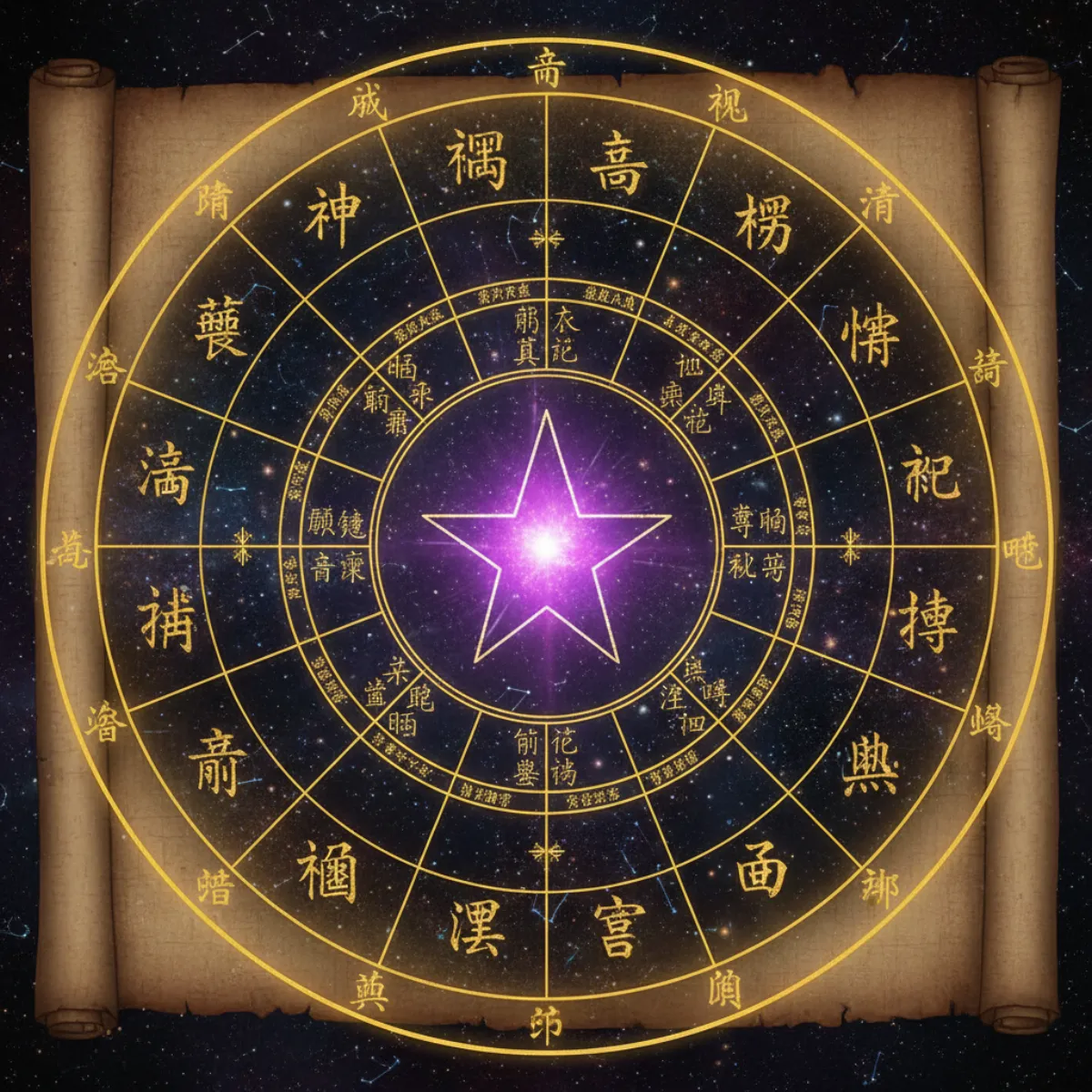
Picture this: a friend hands you a grid filled with Chinese characters. Stars sit in 12 boxes. Arrows point everywhere. “This is your destiny chart,” she says. You nod, completely lost.
That’s how most Westerners first meet Zi Wei Dou Shu (紫微斗数). It looks like a wall of symbols. But millions across East Asia believe it maps your entire life.
Here’s the thing: once you understand the logic behind it, the wall becomes a blueprint. This guide breaks down what this system is, how it differs from Western astrology, and what the core ideas actually mean. No prior knowledge needed.
Ready to see your own chart? → Generate your free Zi Wei Dou Shu chart
What Is Zi Wei Dou Shu?
Zi Wei Dou Shu — pronounced roughly dzih-way doh-shoo — is a Chinese fate-reading system. It dates back to the Tang or Song dynasty (roughly 900–1200 CE).
The name breaks down simply: Zi Wei (紫微) is the Purple Star, the system’s most powerful star. Dou Shu (斗数) means “to count the stars.” Put together: a method of reading destiny by counting star positions.
Simple in concept. Very detailed in practice.
The system runs on your exact birth date and time — year, month, day, and hour. These get converted into the traditional Chinese 60-year calendar (Heavenly Stems and Earthly Branches). From those four data points, a grid of 12 palaces is built. Then about 100 stars are placed across those palaces using classical formulas.
The result? A chart that practitioners use to analyze everything. Career path, financial luck, marriage fit, health risks — all laid out for your entire lifetime in 10-year chunks.
It’s sometimes called Purple Star Astrology in English.
Purple Star Astrology vs. Western Astrology: Same Impulse, Different Architecture
If you’ve had a Western birth chart done, you get the basic idea. Use the moment you were born to understand who you are and what might unfold.
But the two systems are built on very different frameworks. Understanding those differences is the fastest way to grasp what makes this approach unique.
Western astrology centers on planet positions (Sun, Moon, Mercury, etc.) relative to zodiac signs and 12 houses at birth. Your Sun sign, rising sign, and planetary aspects create a snapshot of your personality.
ZWDS uses an entirely different set of “stars.” None of them are real astronomical bodies. The 14 main stars (and dozens of minor ones) are symbolic archetypes. Each one carries specific traits and life themes. They go into a fixed 12-palace grid based on birth calculations — not real-time planetary positions.
A few key contrasts:
| Western Astrology | ZWDS | |
|---|---|---|
| Stars/Planets | Real astronomical bodies | Symbolic archetype stars |
| Chart shape | Wheel/circle | Square grid (12 palaces) |
| Time cycles | Transits, progressions | 10-year decade cycles (大限) |
| Life domains | 12 houses (broad) | 12 palaces (very specific roles) |
| Uniqueness | Many people share same rising sign | Chart is unique to your exact birth hour |
Neither system is “better.” Western astrology shines at describing personality and emotional patterns. Purple Star Astrology is remarkably specific about life events and timing. Many practitioners find it more precise for predicting when things happen — not just what tendencies you have.
The 12 Palaces: Your Life Mapped Across a Grid
The backbone of any Chinese astrology chart is the 12 palaces (十二宫). Think of them as 12 “rooms” in your life. Each one covers a specific area.
Unlike Western houses (which shift based on your rising sign), these palaces have fixed roles. The stars that land in each palace shape how that part of your life plays out.
Here are the 12 palaces and what they cover:
| Palace | What It Covers |
|---|---|
| Ming (命宫) — Life/Destiny | Core personality, life path, innate character |
| Siblings (兄弟) | Siblings, peers, close associates |
| Spouse (夫妻) | Romantic partnerships, marriage quality and timing |
| Children (子女) | Children, creative output, subordinates |
| Wealth (财帛) | Cash flow, financial habits, money-making style |
| Health (疾厄) | Physical constitution, chronic health trends |
| Migration (迁移) | Overseas luck, travel, moving, outside environment |
| Friends (交友) | Social circle, employees, helpers and hindrances |
| Career (官禄) | Professional path, ambition, social status |
| Property (田宅) | Real estate, home life, accumulated assets |
| Fortune (福德) | Inner happiness, spiritual life, karma and leisure |
| Parents (父母) | Elders, mentors, authority figures |
The Ming Palace (命宫) is always the starting point. It’s the single most important palace. The star (or star combo) sitting there defines your core temperament and life direction.
If your Ming Palace holds Zi Wei (the Purple Star), you carry a natural ruler’s energy — commanding and self-reliant. If it holds Tian Tong (the Harmony Star), you tend toward a gentler, artistic path.
The 14 Main Stars: The Characters Running Your Story
The system has about 100 stars total. But 14 main stars (十四主星) carry the most weight. These are the primary characters in your destiny story. Each one is a distinct archetype.
Here’s a quick intro to each:
Zi Wei (紫微) — The Emperor Star The chart’s namesake. Natural authority, high ambitions, and self-reliance that can tip into aloofness. People with this star prominent often end up leading — whether they planned to or not.
Tian Fu (天府) — The Treasury Star Wealth preservation and stability. Conservative, reliable, good at building resources slowly. The tortoise of the 14 stars.
Wu Qu (武曲) — The General Star Action over talk. Financial savvy, decisive energy. Drawn to finance, military, or anything that needs fast, practical judgment.
Tian Xiang (天相) — The Minister Star The diplomat and supporter. Excellent at mediation, admin work, and teamwork rather than solo efforts.
Tian Liang (天梁) — The Elder Star Strong moral compass and protective instincts. Often drawn to medicine, law, or counseling. This star carries a karmic flavor — clear cause-and-effect patterns tend to show up in life.
Tian Ji (天机) — The Strategy Star Quick-thinking and analytical. But prone to overthinking and freezing up. Natural researchers and strategists.
Tai Yang (太阳) — The Sun Generous, outgoing, public-service oriented. Shines in careers that involve visibility and social impact.
Tai Yin (太阴) — The Moon Intuitive, gentle, strong connection to real estate fortune. Often great at behind-the-scenes work.
Tian Tong (天同) — The Harmony Star Peace-loving, artistic, comfortable. Life tends to flow smoothly — though sometimes at the cost of ambition.
Ju Men (巨门) — The Dark Gate The star of the mouth. Communication, controversy, and hidden truths. Great speakers, writers, and debaters. Also the star most tied to disputes.
Lian Zhen (廉贞) — The Prisoner Star Passion, politics, and extremes. This star’s energy is intense. It can bring great power or great trouble — often both.
Tan Lang (贪狼) — The Greedy Wolf Desire, charisma, and a love of life’s pleasures. Very adaptable and magnetic. The most “fun” star, and also the most scattered.
Po Jun (破军) — The Pioneer Star Radical change. Destruction before creation. If this sits in your Ming Palace, expect a life of reinvention — building from scratch, often after tearing down what came before.
Qi Sha (七杀) — The Seven Killings Drive, intensity, all-or-nothing energy. Creates pioneers and executives — people who take big risks and live with the results.
When two main stars share a palace, their energies blend. A palace with both Zi Wei and Tian Fu combines imperial authority with treasury conservatism. That’s a powerful combo for building wealth and status.
The Four Transformations (四化): What Actually Activates Your Chart
Stars in palaces give you the skeleton. But the Four Transformations (Si Hua, 四化) bring it to life.
Each year in the 60-year cycle carries a Heavenly Stem (one of 10: Jia, Yi, Bing, Ding, Wu, Ji, Geng, Xin, Ren, Gui). Your birth year’s stem decides which stars get a transformation — and what type.
The four types:
- Hua Lu (化禄) — Prosperity: Smooth flow, income, abundance. Where Lu lands, things come easily.
- Hua Quan (化权) — Power: Control, authority, dominance. Powerful but sometimes forceful.
- Hua Ke (化科) — Reputation: Fame, academic recognition, good name. Softer than Quan — it polishes and lifts.
- Hua Ji (化忌) — Obstruction: Karmic challenge, blockage. The spot in your chart where life keeps pushing back.
Hua Ji is often the most revealing. Where it lands marks a persistent trouble spot. Not always tragedy — but recurring friction. Someone with Hua Ji in the Wealth Palace might always wrestle with money management. In the Marriage Palace, relationships take more conscious effort.
The transformations work at three levels: natal (lifelong), decade (10-year cycle), and annual (current year). This layering is what lets practitioners make timing-specific predictions.
Curious where your Hua Ji falls? → Get your complete Zi Wei Dou Shu chart
The Decade Cycle (大限, Da Xian): Your Life in 10-Year Chapters
One of the most useful features is the decade cycle (Da Xian, 大限). Starting from birth, each 10-year period of your life activates a different palace as your temporary destiny center.
The starting age for your first decade depends on your birth data. Most people’s first decade begins between age 2 and 14. After that, each decade moves one palace forward.
When a palace becomes your active decade palace, its stars and transformations become the main themes of those 10 years. If your 40s decade hits the Career Palace, that decade focuses on work and achievement. If it hits the Fortune Palace, the focus shifts inward — toward happiness, spirituality, or rest.
Within each decade, you can also check annual luck (流年, Liu Nian). Overlay the current year’s stars onto your natal and decade charts. This creates a three-layer reading — permanent character, 10-year phase, and current-year conditions. It can get very specific about timing.
What Can This System Actually Tell You?
Fair question. Here’s what practitioners typically explore:
Career direction — Which industries and roles fit your star energy? Is your Career Palace strong or challenged?
Financial potential — How does money flow in your chart? Are you better at earning or saving? When are your peak wealth decades?
Relationship patterns — What does your Spouse Palace say about the kind of partner you attract? When do relationships tend to develop?
Health constitution — Which health areas need more attention based on your Health Palace?
Timing — When does your current decade favor action? When is it better to consolidate and wait?
Think of it this way: your chart reveals tendencies and timing, not fixed outcomes. Someone with a difficult Wealth Palace isn’t doomed to be broke. They may need to work harder at financial habits or pick careers that match their star energy. The chart is a map, not a verdict.
Frequently Asked Questions
Do I need to know my exact birth time? Yes. The hour of birth sets your Life Palace (Ming Palace), which anchors everything. Without it, the chart shifts and accuracy drops a lot. If you don’t know your hour, some practitioners use estimated charts — but treat those as rough guides.
Is it the same as BaZi? No. Both are Chinese fate-reading systems using the same calendar. But they work differently. BaZi (八字, “Four Pillars”) analyzes the Five Element balance in your birth data. ZWDS uses those same data points to build a star grid across 12 palaces. Many practitioners study both. For a detailed comparison, see our ZWDS vs BaZi guide.
Can a Westerner get value from this? Absolutely. The system describes universal human experiences — career, relationships, health, wealth. The cultural context is Chinese, but the archetypes are recognizably human. If anything, coming in without strong beliefs about fate lets you engage with it more analytically.
How hard is it to learn? The core structure — 12 palaces, 14 main stars, four transformations, decade cycles — you can grasp in hours. True mastery, where you can blend dozens of stars across multiple chart layers, takes much longer. AI tools have made entry-level chart reading much more accessible.
Your First Step: See Your Own Chart
Reading about it only gets you so far. Real understanding comes from looking at an actual chart — ideally yours.
When you see your stars in your palaces and recognize something true about yourself, the system stops being theory. It becomes a tool you can actually use.
YISHU INSIGHT generates a full Zi Wei Dou Shu natal chart from your birth data. It comes with AI-powered reading in plain English. You’ll see your 12 palaces, main stars, Four Transformations, and current decade cycle — all explained without jargon.
It takes about two minutes. And it’s free.
→ Generate your Zi Wei Dou Shu chart at YISHU INSIGHT
For a step-by-step guide to reading each palace in your chart, see our complete chart reading guide.